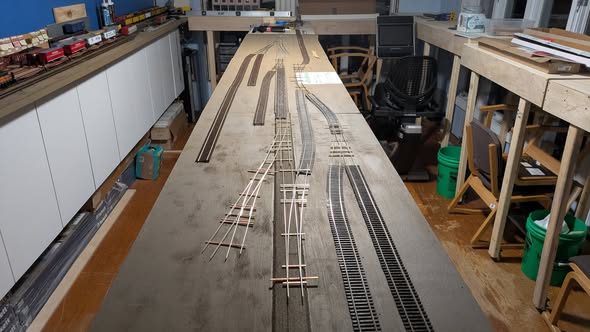
February 27th marked one of the most transformative days in the Cedar River Valley project so far. After months of planning, building, wiring, and steady progress, all twelve modules were finally stood up and locked into place. For the first time, the full footprint of the layout existed in three dimensions, not just on paper or in my imagination. Walking into the room and seeing the entire line of modules stretched out—each one square, level, and ready for the next phase—felt like crossing a threshold. The Cedar River Valley wasn’t just under construction anymore; it was beginning to look like a railroad.
Getting to this point took a tremendous amount of behind‑the‑scenes work. Earlier in the month, we had installed leg brackets and completed wiring on roughly half the modules during a lively work session with Thomas Heilman, Ron Copher, Al Lesky, and Charles Sherman. Their help accelerated the project in a way that simply wouldn’t have been possible alone. But even after that productive day, there was still plenty of work left to do—more wiring, more adjustments, more test‑fitting, and the careful process of ensuring each module would align perfectly with its neighbors. Standing a module isn’t just a matter of flipping it upright; it’s a commitment to its place in the larger whole.
As the final pieces clicked together on the 27th, the room changed. The C&NW Yard in Zone 1 suddenly had real physical boundaries. The future site of the Heileman Brewery in Zone 3 took on a sense of scale that flat benchwork could never convey. And the long, linear presence of Zone 2—the industrial shelf that started this entire project—finally connected visually and physically to the rest of the layout. For the first time, I could walk the length of the railroad and imagine how a train would move through it: entering the yard, working the industries, and navigating the brewery complex. The flow of the layout became something I could feel, not just plan.
Standing all twelve modules also marked the moment when the project shifted from carpentry to railroading. With the benchwork complete, the next major phase—trackwork—could finally begin. This is the stage where the Cedar River Valley will start to reveal its operational personality. Turnouts will define switching patterns. Curves and sidings will shape the rhythm of movements. The yard ladder will take on its familiar form, and the industrial trackage in Zone 2 will begin to feel like a living, working district. Every piece of rail laid from this point forward will bring the layout closer to its 1968 C&NW identity.
More than anything, February 27th felt like a moment of arrival. The modules that Dan Benjamin built with such care back in December now stand as the backbone of the entire railroad. The help from friends earlier in the month made the work lighter and the progress faster. And seeing the full structure assembled brought a renewed sense of excitement and purpose. The Cedar River Valley has reached a major milestone, and the next chapter—trackwork, operations, and the first signs of a functioning railroad—is ready to begin.